
How to Spot Bad Clients Before You Apply
Every veteran freelancer has a horror story. Learn how to decode job postings, spot scope creep, and avoid nightmare clients.
In my first year on Upwork, I took a job to build a "simple" automated email sequence for a real estate agent. The budget was $150.
Three weeks later, I was on my 14th round of revisions. He was calling my personal cell phone at 9 PM on a Tuesday because he didn't like the shade of blue in the email header. I had spent 40 hours on the project and was too afraid of a 1-star review to quit.
Every veteran freelancer has a horror story like this.
On freelance platforms, your connections (connects, credits, bids) cost real money. Applying to terrible jobs doesn't just waste your time; it actively drains your bank account and risks your Job Success Score.
Learning to read between the lines of a job posting is a survival skill. Here are the red flags I look out for today to ensure I never repeat that real estate disaster.
Red Flag #1: "This is a simple/easy/quick task."
This is the single most common red flag in the entire freelancing industry, and I used to fall for it constantly.
If the task is so simple, why isn't the client doing it themselves?
By explicitly categorizing the work as "easy," the client is preemptively negotiating your rate down before you even get on a discovery call.
The translation: "I don't value your specialized skill. I think this should take five minutes. If you quote me a professional rate, I will be deeply offended."
Red Flag #2: The Promise of Future Work
"We are looking for someone to do this trial project for $10. If we like your work, there will be endless ongoing projects at your normal rate!"
This is a trap. I fell for this exact line on Fiverr in 2014. Spoiler alert: the "endless ongoing projects" never materialize.
Clients who respect your talent will respect it from day one. Offering a highly discounted "trial" is a common tactic used by bottom-feeder clients who want cheap work. They cycle through freelancers, promising "future work" to each one in exchange for a discount today.
Evaluate every project based on its standalone financial viability. If you cannot make a profit on the trial alone, pass on the client.
Automate Your Red Flag Detection
Paste any job description into our Client Red Flag Analyzer and let our tool check against 18 known toxic patterns.
Open the Client Red Flag Analyzer →Red Flag #3: Unpaid Spec Work
Speculative work (spec work) involves a client asking you to complete a specific task for their business before they officially hire you. I once had a prospect ask me to "wireframe the homepage so I can see if we vibe" before signing a contract.
A legitimate client evaluates your generalized portfolio and your past reviews. If they want a custom trial for their specific brand, they should pay a small, fixed rate.
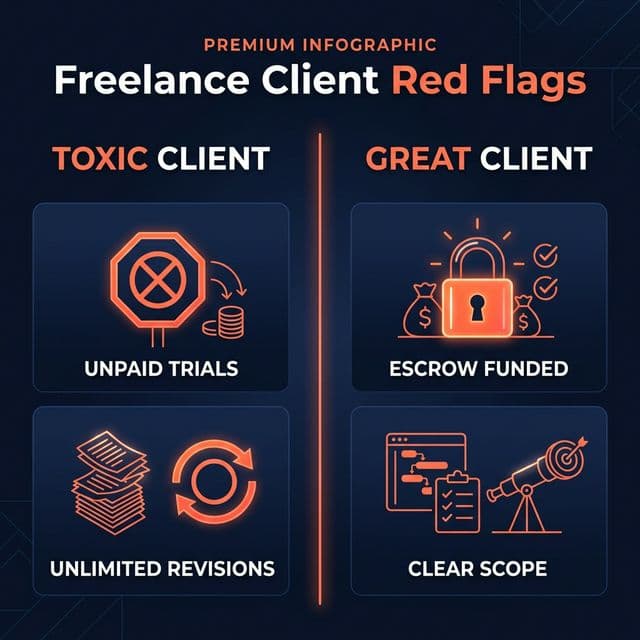
Never do custom work before an escrow contract is funded. Period.
Red Flag #4: Unlimited Revisions
If a client explicitly demands "unlimited revisions until I am 100% satisfied" in the job description, run the other way. This was the exact phrasing my real estate client used.
This signals a client who does not actually know what they want. They expect you to endlessly iterate until they magically see a result they like.
The Professional Approach: My professional contracts now explicitly define scope limits: "This fixed price includes the initial delivery plus two rounds of minor revisions. Further revisions will be billed at $75/hour."
Conclusion
The ability to say "No" is the true mark of a senior freelancer. You are interviewing the client just as much as they are interviewing you.
Trust your gut. If a job posting makes you feel undervalued, anxious, or suspicious, close the tab immediately. There are millions of clients in the world, and you do not need to work with the bad ones to succeed.
Frequently Asked Questions
Should I apply to jobs where the client's payment isn't verified?
Generally, no. While everyone is new to Upwork at some point, submitting proposals to unverified accounts drastically reduces your conversion rate. It is safer to wait until the client verifies their credit card before spending your premium connects.
What if a client wants to communicate outside the platform?
Before a contract is signed, taking communication off-platform (like to Telegram or WhatsApp) violates Terms of Service on platforms like Upwork and Fiverr. Once the contract is officially signed and funded in escrow, you may use whatever tools you prefer.
How do I politely turn down a bad client?
Simply say: "Thank you for the opportunity, but I don't believe I'm the best fit for this specific project at this time. I wish you the best of luck with your launch!" You never owe a client a detailed explanation for passing.