
The Freelancer Tax Guide: What Nobody Tells You About Self-Employment
If you just landed your first freelance check, do not spend it all. Welcome to the world of self-employment tax, quarterly payments, and platform deductions.
Disclaimer: I am a web developer, not a CPA. This guide is built on 15 years of my own freelance mistakes. Tax laws vary aggressively by country, state, and municipality. Always consult a tax professional.
In my second year of freelancing, I made $45,000. I felt like I was finally making it. I bought a new MacBook, took my girlfriend on a vacation, and didn't think twice about the IRS.
Then April hit. My accountant handed me a tax bill for $11,000. I had exactly $800 in my checking account. I spent the next two years on a painful IRS payment plan because nobody sat me down and explained how self-employment tax actually worked.
If you just landed your first freelance check, do not spend it all. Welcome to the confusing world of self-employment tax, quarterly payments, and platform deductions. Here is how you survive it without panicking.
The Double-Tax Whammy
When you have a regular W-2 job, your employer handles the heavy lifting. They withhold your income tax on every paycheck, and they pay half of your Social Security and Medicare taxes.
When you become a freelancer, you become both the employee and the employer. You are now responsible for the entire tax burden. You will generally face two main types of federal taxes on your profit:
- Income Tax: The standard tax on the money you make, based on your tax bracket.
- Self-Employment Tax (SE Tax): This is your mandatory contribution to Social Security and Medicare. It sits at roughly 15.3%. Since you don't have an employer to pay half of it, you pay the whole thing.
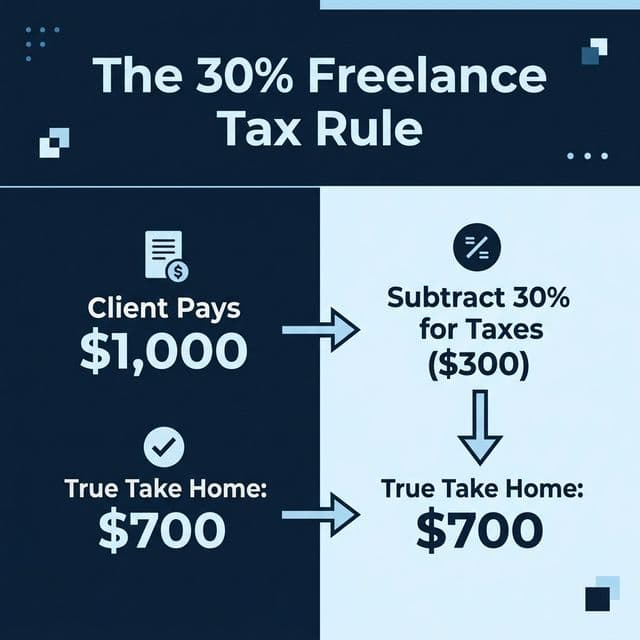
My Golden Rule: The 30% Vault
The moment a client pays an invoice, I manually transfer exactly 30% of that money into a completely separate high-yield savings account explicitly labeled "Taxes." I do not look at it. I do not touch it.
Use our Tax Calculator to see your exact rate in 7 countries →Quarterly Estimated Payments
Because freelancers don't have employers withholding their taxes every two weeks, governments get impatient. They don't want to wait until April to get their money.
If you expect to owe more than $1,000 in taxes for the year (in the US), the IRS requires you to make Quarterly Estimated Tax Payments.
This means four times a year (April, June, September, and January), I sit down, estimate my profit for the last three months, and literally write a check to the US Treasury. If I forget to do this, I face underpayment penalties at the end of the year.
Platform Fees vs. Taxes
A common mistake I see beginners make is confusing Upwork fees with taxes.
If you bill $1,000 on Upwork, Upwork takes a 10% cut ($100), leaving you with $900. Upwork does not withhold income taxes for you.
That $900 sitting in your direct deposit is still untaxed gross income. You must still save roughly 30% of that $900 ($270) to give to the IRS.
The Magic of Write-Offs (Deductions)
The silver lining of freelance taxes is deductions. You only pay taxes on your Net Profit, not your Gross Revenue.
If I made $50,000, but I spent $10,000 on legitimate business expenses, I only pay taxes on $40,000. Here are the things my CPA forces me to track every single month:
- Platform Fees: Yes, the 10% Upwork fee or 20% Fiverr fee is a fully deductible business expense.
- Software: My Vercel hosting, Figma subscription, and Adobe Creative Cloud.
- Hardware: That new MacBook I bought? Deductible (usually depreciated over a few years).
- Home Office: A percentage of my rent and utilities, since I have a dedicated bedroom just for working.
When Should You Form an LLC or S-Corp?
Most freelancers start as Sole Proprietors because it is free and automatic. I operated as a Sole Proprietor for four years.
Eventually, my CPA advised me to form an LLC. An LLC protects your personal assets (like your house) if a client ever sues you for breaking their website. From a tax perspective, a single-member LLC is taxed exactly the same as a Sole Proprietor.
The S-Corp Advantage: Once I started netting over $70,000 a year, my CPA elected my LLC to be taxed as an S-Corp. This allowed me to put myself on a W-2 payroll and take the rest of the business profit as "distributions," which are exempt from the brutal 15.3% Self-Employment tax. It saved me thousands, but requires paying for Gusto payroll software and a more expensive tax return. Wait to do this until you have steady, high income.
Conclusion
The sheer horror of freelance taxes comes entirely from being unprepared.
Open a separate business checking account today, never buy personal groceries on your business card, track your software receipts, and religiously save 30% of every invoice for tax day. Keep the money organized, and you'll never have to fear the IRS.
Frequently Asked Questions
Can I write off my coffee shop purchases?
If you go to a coffee shop just to work on your laptop, the coffee is generally NOT deductible, as it's considered a personal living expense. However, if you are explicitly buying coffee while conducting a business meeting with a client, it may be 50% deductible under meals and entertainment.
Is an LLC required to freelance?
No. You automatically default to a Sole Proprietor in the US the moment you start charging for services. An LLC is a legal structure for liability protection, not a tax requirement for starting out.
Do I have to pay taxes on money sitting in Upwork?
Yes. The IRS operates under the doctrine of "constructive receipt." The moment funds are made available to you in your Upwork or Fiverr balance, they are considered taxable income, whether you withdraw them to your bank account or not.