
How to Price Your Freelance Services Without Scaring Clients Away
The ultimate guide to calculating your baseline, abandoning the hourly trap, and confidently communicating your worth to potential clients.
I still remember the knot in my stomach the first time a client asked for my hourly rate. I was sitting at a tiny desk in my bedroom in 2011, staring at a blank email draft for forty-five minutes.
I ended up typing "$15/hour" because it felt safe. I didn't want to scare them away.
That was my first major mistake as a freelancer. I spent many years working 60-hour weeks just to barely crack minimum wage, secretly resenting my clients because I was chronically underpaid.
If you are guessing your freelance rates based on what you feel you deserve, or worse, based on what you think the client can afford, you aren't running a business. You're running a charity.
Let's talk about how to stop guessing, abandon the hourly trap, and actually get paid what your time is worth.
Step 1: Finding Your "Walk-Away" Number
My turnaround didn't happen until I sat down and did the actual math. Before you can confidently pitch a client, you need to know your absolute floor. This is your "Walk-Away Number."
To find it, you have to kill the 2,080-Hour Myth.
What is the 2,080-Hour Myth?
A standard full-time employee works 40 hours a week for 52 weeks (2,080 hours). Freelancers do not. You have to account for unbillable business tasks.
When I tracked my actual time, I realized I was spending nearly 40% of my week doing things I couldn't charge for:
- Pitching and writing proposals on Upwork
- Chasing down late invoices
- Updating my portfolio to try and win bigger jobs
- Attending pointless scoping calls that went nowhere
A highly efficient freelancer realistically bills closer to 1,200 hours per year.
So, if I needed to make $75,000 just to survive in my city, I couldn't divide it by 2,080. I had to divide $75,000 by 1,200. My actual minimum baseline rate had to be $62.50 per hour, not $36/hr.
Automate The Math
Don't want to run the numbers manually? I built a calculator that factors in unbillable hours, vacation, and self-employment taxes for you.
Open the Hourly to Salary Converter →Step 2: The "Freelancer Premium"
Once I hit $60/hr, clients started asking: "Why do you charge $60 an hour when I can hire an employee for $35?"
I used to get defensive. Then I learned the truth: freelancers actually cost companies less overall.
When a company hires an employee, they pay for health insurance, 401k matching, payroll taxes, office space, employer liability, and paid time off. When they hire me, they just pay a flat invoice.
You are legally required to charge a premium to cover the benefits you are providing for yourself.
My standard rule now is that my freelance rate must be 30% to 40% higher than what I would accept as a full-time employee, simply to break even on taxes and healthcare.
Step 3: Escaping the Hourly Trap
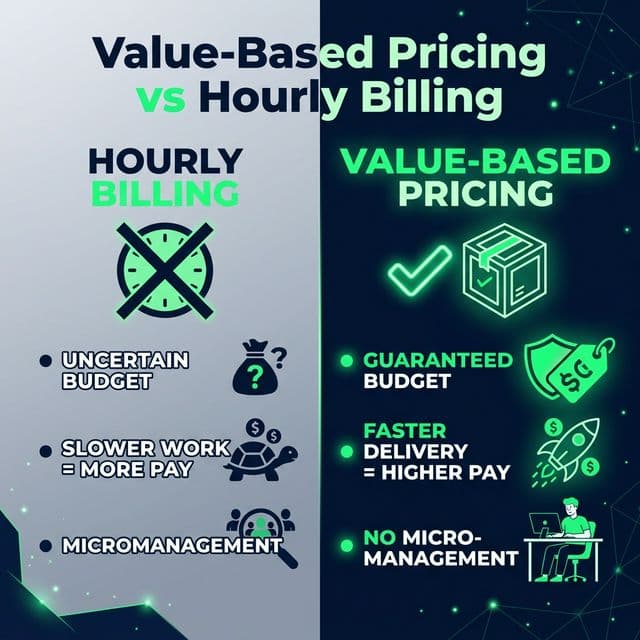
This was the hardest pill for me to swallow: hourly billing actively punishes you for getting better at your job.
In my first year, it took me 10 hours to build a landing page. At $50/hr, I made $500.
Years later, I had a custom component library and could knock out a superior landing page in just 4 hours. Under hourly billing, I was now making $200 for a better product. I got penalized for being an expert.
This is exactly why I shifted to Value-Based Pricing.
How I Pitch Value Instead of Time
Now, when a client asks for my hourly rate, I never give them a number. I say:
"I actually prefer to price by the project. This gives you a guaranteed budget with zero surprises. Can we discuss the scope so I can give you a fixed quote?"
Once I understand the scope, I use my internal hourly baseline to generate the quote. If I think the project will take 20 hours, and my internal rate is $75/hr, the internal cost is $1,500. I add a 20% "buffer" for the inevitable scope creep, and quote the client a fixed price of $1,800. If I finish in 10 hours, I just effectively doubled my hourly rate.
Step 4: The Art of the Rate Increase
Here's a secret: if you are booked solid for the next month, your rates are too low. Your goal shouldn't be to win 100% of your proposals. It should be to win 30% to 40% of them at a premium price point.
The easiest way I found to raise my rates without crippling anxiety was the "Next Client Rule."
I kept my current clients at their existing rate to maintain stable income. But for the very next lead that hit my inbox, I quoted 20% higher than normal.
When the first client said "yes" to the new rate, I was ecstatic. After three clients said yes, that simply became my new rate. I repeated this process every year until I finally started getting consistent pushback.
Conclusion
Pricing will always feel a little subjective, but the mathematics of survival are not. Do the math, figure out your absolute baseline to cover your overhead, and transition to fixed-price projects the minute your estimation skills become accurate.
Stop competing on who can be the cheapest, and start competing on who can deliver the most peace of mind.
Frequently Asked Questions
Should I show my pricing on my website?
Yes, but use starting rates (e.g., "Websites starting at $2,500"). This filters out clients with a $200 budget before they ever waste your time on a discovery call, while leaving room to quote higher for complex projects.
How do I raise rates on existing clients?
Give them 30 to 60 days of advance notice. Keep it professional and brief: "To keep up with rising operational costs and demand, my new rate will be $X effective [Date]. I appreciate your continued partnership."
What if a client says my rate is too high?
Never just lower your rate, as it devalues your service. Instead, reduce the scope of the project to match their budget. If they want the full scope, they must pay the full rate.